For career centers and engineering colleges
Get your engineering students ready for the career fair
Plenty of strong engineering students walk up to a recruiter with no idea what to say first. I spend one to three days on your campus around the career fair and coach them one at a time. I’m a Montana Tech engineering grad who went on to ExxonMobil, BP, Yale, GE Capital and CEO of a regional law firm.
I build and run the schedule, so your career center isn’t planning one more event. I built this format at Montana Tech, my alma mater, where I volunteer, and in three days in September 2025 I coached students one-on-one and reviewed dozens of resumes.
What your campus gets
More coaching hours before the fair, without more staff
Your engineers are strong technically, and the recruiter's booth can still be hard. I've been there. Does your career center have the hours to coach every engineer before the fair? And when your dean asks what students were struggling with, do you have something you can hand over?
Here's what a visit covers:
- Students who know which companies to see, how to open a conversation, and what to ask once they're talking.
- A visit I plan and run, so your staff isn't adding work.
- A short report afterward on what students asked and where they got stuck.
- Something students keep after I leave, like the free one-page guide to the 7 Unwritten Rules, plus Foundations seats if you want the help to carry into their first jobs.
I'd love for recruiters to drive home talking about how ready your engineers were. If you tell me when your fair is, I can sketch how the days would fit around it.
The program
One to three days on campus around your career fair
Students get one-on-one time with someone who has done the hiring (as a CEO I recruited and coached a full executive team) and who still remembers feeling lost in his first engineering job. Your career center gets a full schedule it doesn’t have to build, plus a short report afterward.
Last Stop Before the Fair
I set up right outside the career fair doors and stay there all day. Students stop on their way in and we check the handshake, the resume, the first question they plan to ask, and the nerves. Some need thirty seconds and some need five minutes. I’ll hold your backpack while you straighten your tie, and then you go in!
What else is on the menu
Walk-up office hours. No appointment, and bring a resume or don’t. Students leave with a free LinkedIn headshot, a read on their resume and a plan for the fair.
Interview prep workshop. The 30-second pitch, “tell me about yourself,” STAR stories, technical questions, and what to say when you don’t know the answer.
Foundations seat licenses. Give a graduating class or a cohort of new alumni access to the Foundations course on how companies actually run.
A short report after the visit. What students asked and where they struggled.
Pricing
Let’s talk. The cost depends on how many days you want and what goes in them.
Started at my alma mater, Montana Tech
Montana Tech is my alma mater, and I serve on the Montana Tech Foundation board. Everything I do on that campus is volunteer work. Montana Tech hasn’t hired me for this and isn’t endorsing this page, but it is where I built and tested the format you can book.
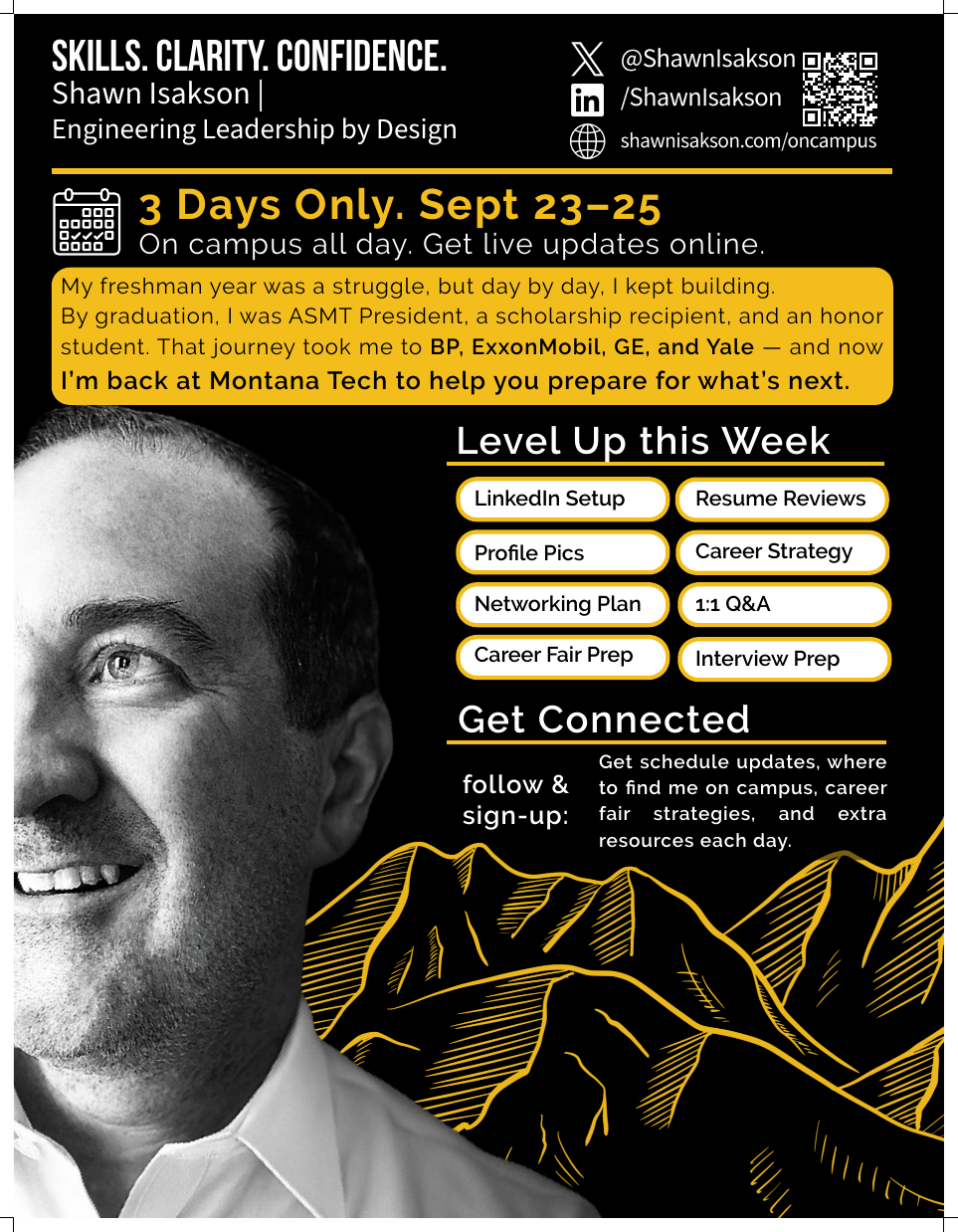
Fall 2025, three days (Sept 23 to 25)
A LinkedIn and professional branding session
A leadership roundtable with the elected student government
A career workshop and resume lab
Working sessions with the Chancellor, Vice Chancellor and Dean of Students
A full day of one-on-one coaching at the career fair
In those three days I met so many students, reviewed dozens of resumes, and took LinkedIn headshots in the hallway with my phone (nothing fancy). Every student asked me some version of “Am I enough?”
After the visit, Montana Tech Career Services sent my follow-up note to all students.
Fall 2026, the career fair (Sept 16 to 17)
I went back for the career fair and held walk-up office hours in the student union, with a free LinkedIn headshot, a read on the resume and a plan for the fair. On fair day I set up outside the doors for Last Stop Before the Fair.
Why me
I grew up in Butte and studied engineering at Montana Tech. My freshman year was a struggle, but day by day I kept building, and by graduation I was Student Body President. Fresh out of school I landed in ExxonMobil’s Major Projects Division and felt completely lost. I wasn’t sure where I fit or how to do well, and it took years to get confident.
After an East Texas rig at 24, I spent four years with BP in Alaska and led the first phase of the Prudhoe Bay pipeline replacement. Then came Yale, energy financing at GE Capital, and CEO of a regional law firm of about 50 attorneys. Those stories come to campus with me. What would you most want your engineers to know before the fair?
Plan a campus visit
Tell me about your campus and when your career fair is, and I’ll set up a short call. If you’re curious about Foundations seats for your students, mention that too. No pressure at all, even if you just want a rough sense of pricing for next year.
FAQ about career fair prep for engineering students
How can universities prepare engineering students for job interviews?
Students need to practice out loud and get feedback. That means a 30-second pitch, a “tell me about yourself” answer, two or three STAR stories, and a plan for technical questions. I run a workshop first and follow it with one-on-one coaching.
Can an industry executive coach our students before the career fair?
Yes. That’s what I do. I come to campus for one to three days built around your career fair, with the schedule and the short report handled for you.
What happens at Last Stop Before the Fair?
I set up right outside the career fair doors. Students stop on the way in for a quick check of their handshake, resume, first question and nerves, and then they go in.
Can a career center offer a career course to a whole class?
Yes. Foundations seat licenses give a graduating class or a new-alumni cohort access to the Foundations course on how companies actually run. We’d set the terms and the number of seats together.
Ready to plan your career fair week?
I’d like to spend one to three days on your campus around your fair, coaching your engineers before they reach the booths. When is your next one?